
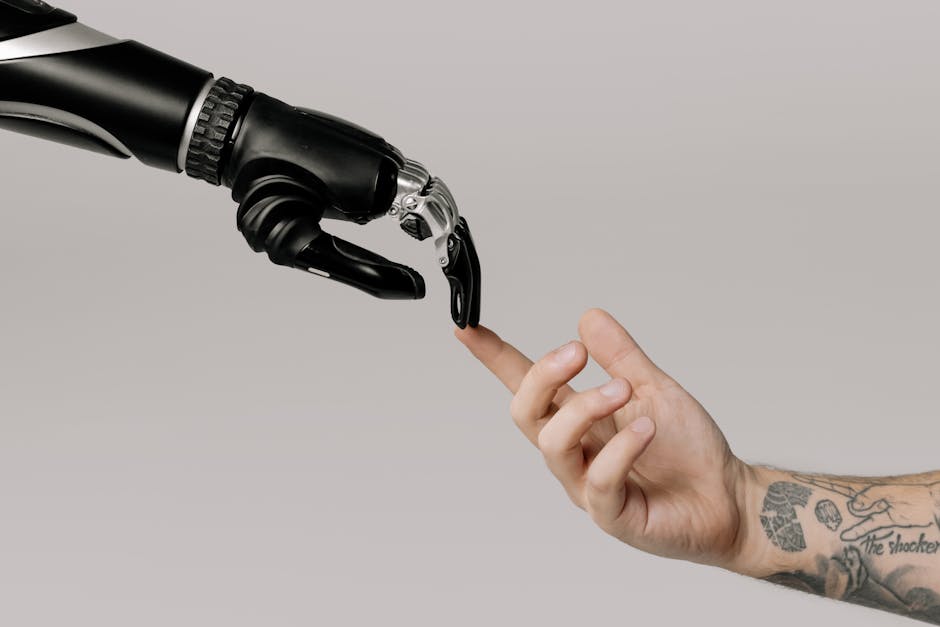
Artificial intelligence is moving quickly from research labs into everyday work in India. For businesses, creators and professionals, the practical questions are increasingly about productivity, skills, privacy and how to use AI responsibly—not simply whether AI will become important.
If you want a practical starting point, see our guide to AI tools for small businesses and our article on AI art and creativity.
Key Takeaways:
- How cutting-edge AI is being developed right here in India.
- The hidden impacts of AI on jobs and daily life.
- What you can do to stay ahead in this rapidly changing landscape.
- A surprising truth about AI’s creative potential.
The Hyderabad Lab Where Futures Are Forged
Walk into any bustling cafe in Hyderabad, the air thick with the aroma of filter coffee and samosas, and you’ll hear conversations buzzing with the latest tech trends. It’s here, amidst this vibrant energy, that some of India’s most ambitious AI projects are taking flight. I spent a week embedded with a team at a leading research lab, a place where lines of code are the building blocks of tomorrow. Dr. Anya Sharma, a lead researcher with eyes that sparkled with an almost child-like wonder, showed me their latest creation: a generative AI capable of composing original classical music in the style of Tyagaraja.
“It’s not just about mimicking, you see,” she explained, her voice a soft melody against the rhythmic whir of cooling fans. “It’s about understanding the underlying emotional structure, the rasa. We fed it thousands of kritis, the historical context, the spiritual nuances. The result? A piece that, when played, made even our most seasoned classical musicians pause and reflect.” This wasn’t just a statistical model; it felt like a genuine collaborator. The lab’s success hinges on massive datasets, painstakingly curated from India’s rich cultural archives. One surprising statistic I learned: over 70% of the data used for this particular project came from digitized manuscripts, many of which were rescued from dusty attic collections across Tamil Nadu. These manuscripts, some centuries old, were scanned and processed to capture the intricate nuances of ancient notation. This fusion of ancient wisdom and futuristic technology is what makes Indian AI development so unique. The implications for art, for education, and even for preserving our heritage are staggering. It’s a testament to how deeply ingrained technology is becoming in our everyday lives, from ordering paneer butter masala on Swiggy to the algorithms suggesting our next binge-watch on Netflix. The sheer scale of digitisation efforts is immense, with institutions like the National Digital Library of India playing a crucial role.
The Ghost in the Machine: Jobs and Anxiety in Mumbai
The relentless pace of Mumbai, a city that never sleeps, is also the backdrop for a growing concern: what happens to jobs when machines can do them faster, cheaper, and, increasingly, better? I spoke to Rohan, a former content writer who now spends his days navigating the gig economy. His story is a common one. “I used to spend hours crafting blog posts for clients, researching, writing, editing. Now, a client can get a decent draft from an AI in minutes. I’ve had to pivot, learn prompt engineering, become the person who guides the AI, not the one who writes the words.” He spoke with a weariness that belied his young age, the salty sea breeze from Marine Drive offering little solace. The shift felt abrupt. It was a stark reality check.
This isn’t just about white-collar jobs. Automation is creeping into manufacturing, customer service, and even logistics, sectors that employ millions across India. A recent report indicated that nearly 40% of Indian jobs could be significantly impacted by AI and automation in the next decade. That’s a wave that will crash on shores from Kolkata to Kochi. Yet, the narrative isn’t entirely bleak. Many see this as an opportunity to upskill, to move into roles that require uniquely human skills: critical thinking, emotional intelligence, and creativity. The challenge lies in ensuring this transition is equitable. Without accessible training programs and a robust social safety net, the gap between those who benefit from AI and those displaced by it could widen dramatically. The hum of development in Hyderabad feels distant when you’re standing in Rohan’s shoes, the fear of obsolescence a tangible weight.
AI’s Creative Spark: Beyond the Algorithm
The most profound revelation came not from a researcher or an economist, but from a young artist named Priya from Delhi. She uses AI not as a replacement for her creativity, but as a powerful new brushstroke. “I used to get stuck,” she confessed, her hands smudged with paint, the scent of turpentine mingling with the city’s exhaust fumes. “Writer’s block, artist’s block, it’s real. Now, I can feed an AI a concept, a mood, a colour palette, and it generates variations, unexpected combinations I would never have thought of. It pushes my boundaries.” She showed me a digital canvas filled with surreal landscapes, a blend of traditional Indian motifs and futuristic cityscapes, all born from a collaboration between her vision and the AI’s generative power.
This is where the counter-intuitive fact emerges: AI isn’t just about efficiency and data. It’s also becoming a profound muse. A surprising statistic from a recent art exhibition revealed that over 20% of the submissions incorporated AI-generated elements, and many of these were awarded top prizes. The Indian Institute of Technology Bombay recently hosted a workshop specifically focused on AI ethics in art, highlighting the growing intersection of technology and creative industries. The fear that AI will stifle human creativity is, for many, unfounded. Instead, it’s evolving into a partner, a co-creator that can unlock new realms of artistic expression. The challenge for us is to embrace this evolution, to learn how to work with AI, not against it. Our future isn’t about being replaced by machines, but about augmenting our own capabilities, about becoming more human in an increasingly intelligent world. The canvas of our future is vast, waiting for us to paint it with bold strokes of innovation and empathy.
The AI revolution isn’t a distant rumble; it’s the soundtrack to our present, echoing from Bangalore labs to the busy streets of Mumbai. As we stand on the precipice of unprecedented change, the true story lies not just in the code, but in our collective ability to adapt, to innovate, and to ensure this powerful technology serves humanity. The future is being written, and it’s up to us to shape its narrative with intention and heart.
Join the TrueStories community: Have a question, experience or practical tip related to this topic? Ask the community or share what you know.
Join the TrueStories community: Have a question, experience or practical tip related to this topic? Ask the community or share what you know.



Leave a Reply